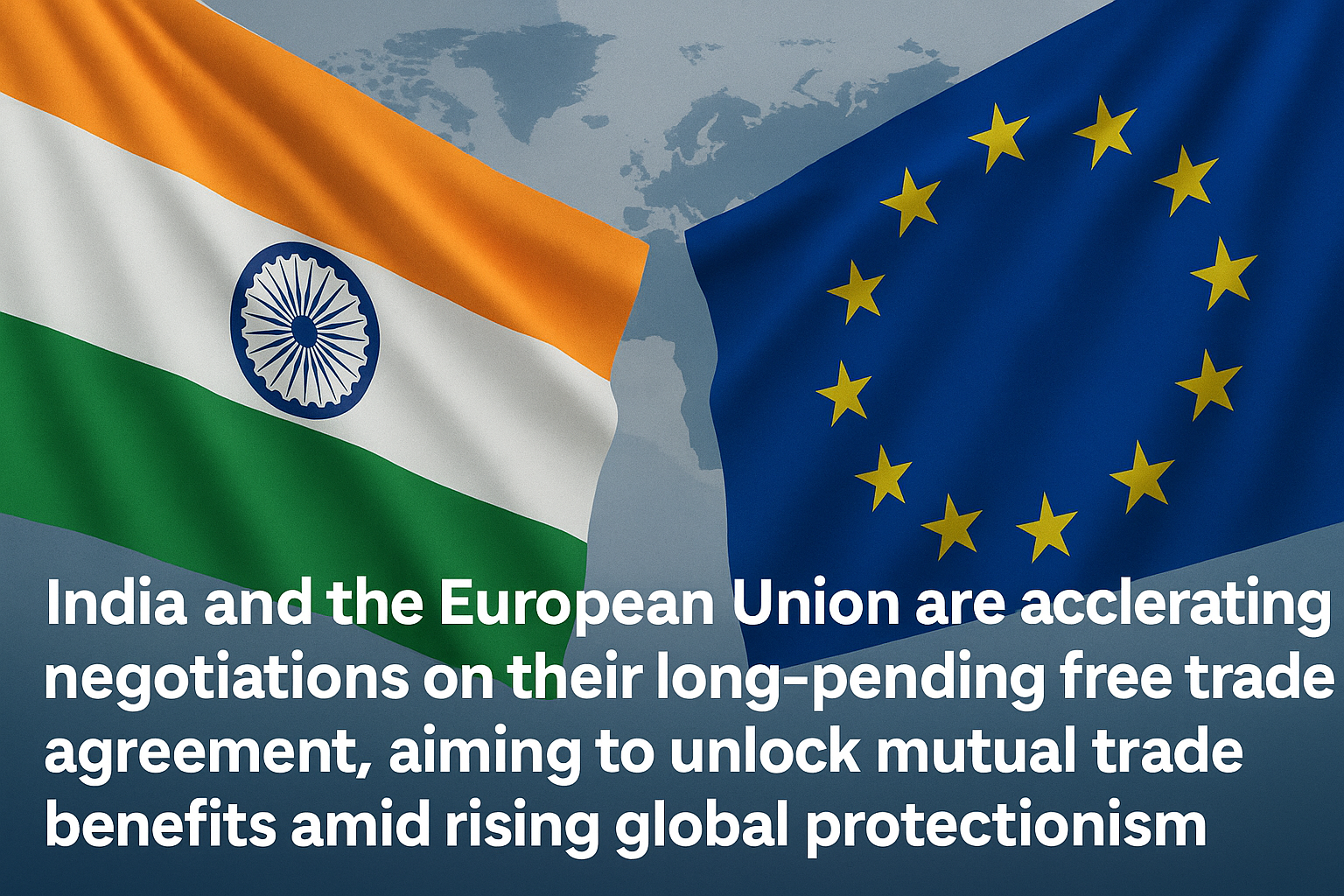
India and the European Union are inching closer to resolving their long-pending Free Trade Agreement (FTA), particularly focusing on cutting down tariffs in two key sectors—Indian textile exports and premium EU alcoholic beverages. With rising global protectionism shaking up trade dynamics, this FTA presents a significant opportunity to reset and deepen economic ties. This blog takes an in-depth look at the evolving negotiations, key developments, and their potential impact on both economies.
Why the FTA Negotiations Matter
The India-EU FTA is not just another trade agreement. It represents mutual economic collaboration between the world’s largest democratic economy and one of its most substantial trading blocs. Together, India and the EU account for a combined GDP of roughly $18 trillion, making this partnership an essential pillar in global trade. Concluding this agreement would mean reducing trade barriers, boosting exports, and providing market access to industries in both countries.
Amid tense global trade situations, such as escalating U.S. tariff threats, advancing this FTA sends a clear signal about the possibilities of economic cooperation in an increasingly divided economic landscape.
Tariff Reductions Take Center Stage
Central to the ongoing negotiations is the tariff reduction framework for Indian textiles and EU premium alcoholic beverages. The current scenario places significant hurdles:
- Indian Textile Exports: Indian garments headed to the EU face duties as high as 14%, while neighboring Bangladesh enjoys duty-free access under the “Everything But Arms” (EBA) initiative. This disadvantage has led to Bangladesh commanding a 21% share of the EU apparel market, compared to India’s modest 5%.
- Premium European Alcohol: India levies tariffs of up to 150% on imported spirits, deterring European distillers from fully tapping into the fast-growing Indian market.
By reducing tariffs in these areas, both parties are looking at a win-win scenario. India would gain much-needed duty-free access, leveling the playing field for its textile industry, while the EU could secure a more lucrative footing for its brands in India’s thriving alcohol market.
Key Negotiation Insights
Proposed Framework for Alcohol Tariffs
Unlike the India-Australia FTA, which uses a phased price-band reduction model, the India-EU negotiations are looking at alternative pathways. Flat phased reductions or threshold-based models are being proposed to cater specifically to premium European offerings.
Boost for Indian Textiles
Experts suggest that reduced EU tariffs on Indian textiles could have a game-changing effect on India’s market share. Eliminating duties could potentially double India’s apparel exports to the EU, bolstering job creation and enhancing industry competitiveness.
Balancing Local and International Interests
A significant point of contention has been ensuring that local industries in both India and the EU are adequately protected. The Confederation of Indian Alcoholic Beverage Companies (CIABC) advocates for phased tariff reductions on European spirits, alongside strict rules of origin to prevent misuse of trade concessions.
Industry Optimism from Key Sectors
Textiles
For India’s textile industry, the FTA could be groundbreaking. Prabhu Dhamodharan, convenor of the Indian Texpreneurs Federation, underscores this sentiment, stating that duty-free access to the EU could double India’s market share within two years. This would translate to potential exports of $9 billion annually, alongside the creation of up to 700,000 new jobs.
The EU remains a coveted export destination for Indian textiles, importing a remarkable $92 billion annually in apparel. A significant reduction in tariffs would allow Indian exporters to compete directly with Bangladesh and other market leaders.
Alcoholic Beverages
On the flipside, the Indian alcohol industry has cautiously welcomed the idea of tariff reductions on European spirits. While premium alcoholic beverages like Scotch whisky could gain traction in the growing Indian market, industry stakeholders emphasize the importance of gradual reductions over a decade to mitigate risks for domestic producers.
Anant S. Iyer, director general of the CIABC, highlights, “Reducing duties from the current 150% to 50% over 10 years ensures protection for Indian manufacturers while simultaneously creating opportunities for premium European exports.”
Strategic Importance for Bilateral Ties
The current discussions are happening against the backdrop of shifting global trade priorities. Both India and the EU are keen to conclude negotiations by the end of 2025, a goal reiterated during EU President Ursula von der Leyen’s February visit to India. The timeline signals a shared urgency to fortify bilateral ties amid growing protectionist tendencies worldwide.
The most recent round of negotiations in Brussels covered various issues, including tariff structures, investment protection, and government procurement. Talks on a separate geographical indication (GIs) agreement, focusing on products like French champagne and Basmati rice, also continue alongside the FTA discussions.
Recent Developments and Context
Declining Indian Textile Exports
India’s textile and apparel exports to the EU have contracted in recent years, decreasing from $10.83 billion in FY22 to $9.66 billion in FY24. A robust FTA could help reverse this trend and provide a significant boost to struggling sectors.
U.S.-EU Trade Dynamics
Meanwhile, on the alcohol front, India recently reduced import duties on U.S. whiskies from 150% to 100% as a goodwill gesture, further intensifying competition for European exports in the premium segment. Such moves raise the stakes for a timely resolution to the India-EU agreement.
What’s Next for the India-EU FTA?
The next round of negotiations is slated for May in New Delhi, where finer details of tariff reductions and market access will be hashed out. The focus will likely remain on balancing economic benefits while protecting domestic industries.
Trade Opportunities Amid Global Protectionism
At a time when protectionist policies are dominating global trade discussions, the India-EU FTA holds promise as a blueprint for constructive collaboration. For India, smoother access to the EU could unlock vast economic opportunities for exporters, particularly in textiles. Simultaneously, European producers could finally tap the vast potential of India’s developing premium alcohol market.
If successful, this agreement would signal not just a strengthening of bilateral trade ties, but also a shared commitment to counterprotectionism with mutually beneficial partnerships.
Feel free to share your experiences and insights in the comments below. Let’s continue the conversation and grow together as a community of traders and analysts.
By sharing this experience and insights, I hope to contribute to the collective knowledge of our professional community, encouraging a culture of strategic thinking and informed decision-making.
As always, thorough research and risk management are crucial. The dynamic nature of financial markets demands vigilance, agility, and a deep understanding of the tools at your disposal. Here’s to profitable trading and navigating the election season with confidence!
Ready to stay ahead of market trends and make informed investment decisions? Follow our page for more insights and updates on the latest in the financial world!
For a free online stock market training by Yogeshwar Vashishtha (M.Tech IIT) this Saturday from 11 am – 1 pm, please sign up with https://pathfinderstrainings.in/training/freetrainings.aspx
Experience profits with my winning algo strategies – get a free one-month trial with ₹15 lakh capital! – https://www.terminal.algofinder.in/auth/register
Disclaimer
This article should not be interpreted as investment advice. For any investment decisions, consult a reputable financial advisor. The author and publisher are not responsible for any losses incurred by investors or traders based on the information provided.