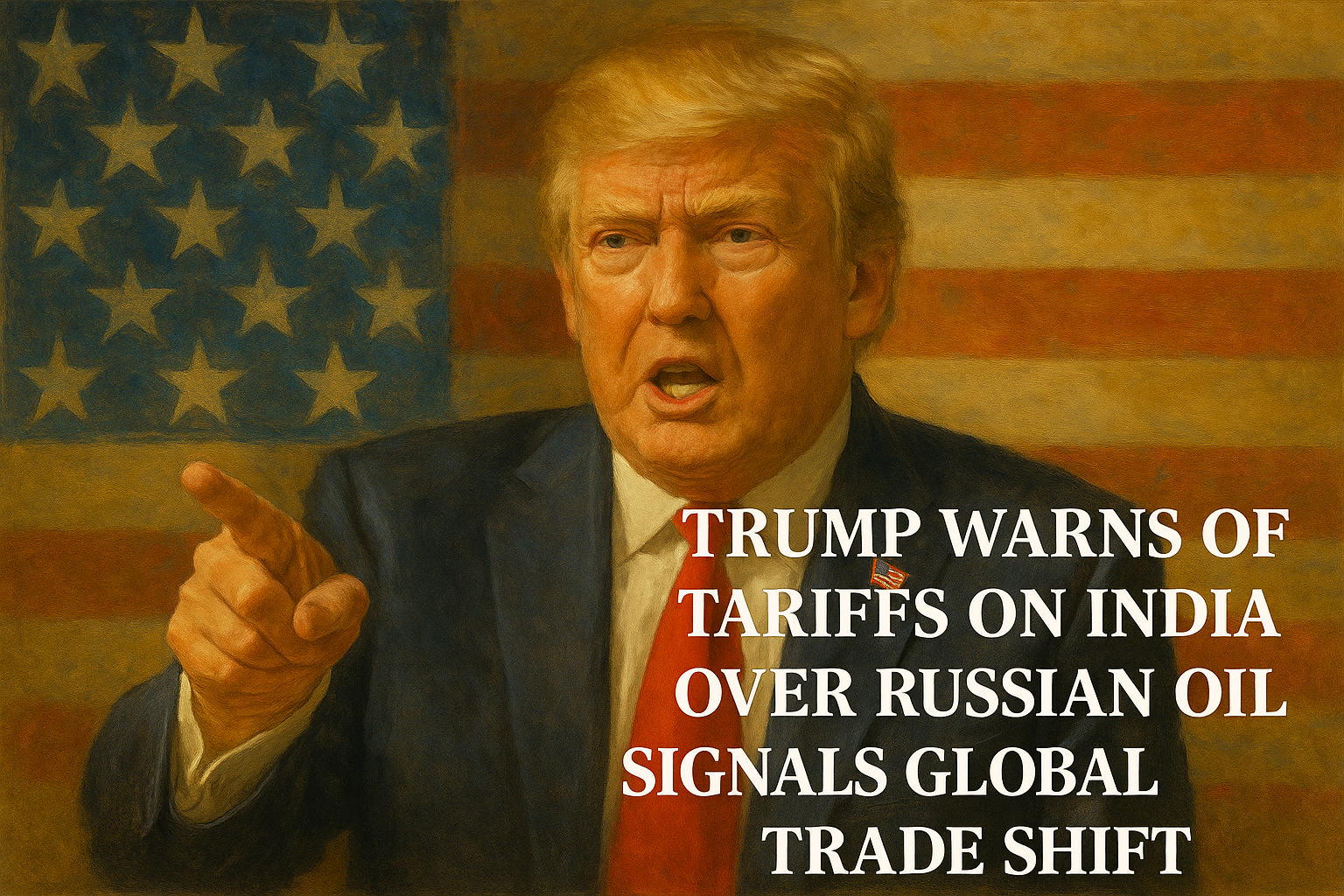
In a striking interview on August 5, US President Donald Trump delivered a series of aggressive policy declarations that sent ripples through international economic and political circles. His remarks touched on everything from Indo-American trade to the semiconductor supply chain, revealing a renewed push for economic nationalism and geopolitical leverage.
1. Tariff Threat on India Over Russian Oil Imports
President Trump issued an explicit threat to India, indicating that his administration may impose “substantially” increased tariffs within the next 24 hours. The trigger: India’s continued oil imports from Russia.
Trump stated, “India has not been a good trading partner… they’re buying Russian oil.” He accused New Delhi of enjoying disproportionate trade benefits and engaging in unfair practices. According to the President, the current 25% tariff rate was no longer sufficient and would be revised sharply upward unless India reorients its energy strategy.
If executed, the move is expected to sour already-tense US-India trade relations and could provoke retaliatory measures from India. The timing and immediacy of the threat also introduce new instability into global energy markets and bilateral diplomacy.
2. Economic Pressure as a Tool Against Russia
President Trump linked oil prices directly to geopolitical outcomes, suggesting that a significant drop in global energy prices could halt Russian military operations in Ukraine.
“If energy goes down another $10 a barrel, he’s going to have no choice,” Trump said, referring to Russian President Vladimir Putin. This perspective underscores Trump’s belief in economic levers over traditional military or diplomatic strategies, with crude oil revenue positioned as Russia’s Achilles’ heel.
3. New Tariffs Looming on Pharmaceuticals and Semiconductors
In addition to targeting India, Trump revealed that his administration is preparing to roll out new tariffs on pharmaceuticals and semiconductors—two strategic sectors with deep global supply chains.
On pharmaceuticals, he proposed an initial small tariff that would scale rapidly: “In one year — one and a half years, maximum — it’s going to go to 150% and then to 250%,” he warned. This effort is framed as a strategy to force pharmaceutical manufacturing back into the United States.
Similarly, Trump hinted at an impending move on semiconductors, suggesting that both national security and industrial self-sufficiency are behind these measures. These tariffs, if enacted, would have significant repercussions for global supply chains, potentially disrupting imports and creating pricing volatility.
4. Accusations Against Major US Banks
In a pivot to domestic matters, Trump criticized major American banks, accusing them of politically motivated discrimination. He specifically called out institutions like Bank of America and JP Morgan for allegedly sidelining conservatives and Trump supporters.
“They discriminate against Trump supporters more than conservatives in general,” he claimed, injecting further tension into the already polarized landscape of corporate and political alignment.
5. No Interest in Fed Chair Role From Treasury Secretary
President Trump also clarified speculation around the next chair of the Federal Reserve. He revealed that Treasury Secretary Scott Bessent had declined interest in replacing Jerome Powell.
“I asked him… he said, ‘Nope, I want to stay where I am,’” Trump noted. He added that other candidates — notably Kevin Warsh and Kevin Hassett — were being considered, though no decision would be made imminently.
6. Republican Ambitions in Texas
Turning briefly to electoral strategy, Trump alluded to potential Republican gains in Texas, stating, “We have an opportunity in Texas to pick up five seats,” though he offered no further details. This signals the administration’s intent to leverage redistricting in key battleground states.
Trump’s wide-ranging interview paints a picture of a presidency leaning heavily into protectionist policies, economic coercion, and political messaging tailored to a domestic base. With promises of swift tariff escalations and reshuffling of key economic posts, the coming days are likely to bring substantial changes to the global trade environment—and heightened diplomatic tensions.
Feel free to share your experiences and insights in the comments below. Let’s continue the conversation and grow together as a community of traders and analysts.
By sharing this experience and insights, I hope to contribute to the collective knowledge of our professional community, encouraging a culture of strategic thinking and informed decision-making.
As always, thorough research and risk management are crucial. The dynamic nature of financial markets demands vigilance, agility, and a deep understanding of the tools at your disposal. Here’s to profitable trading and navigating the election season with confidence!
Ready to stay ahead of market trends and make informed investment decisions? Follow our page for more insights and updates on the latest in the financial world!
For a free online stock market training by Yogeshwar Vashishtha (M.Tech IIT) this Saturday from 11 am – 1 pm, please sign up with https://pathfinderstrainings.in/training/freetrainings.aspx
Experience profits with my winning algo strategies – get a free one-month trial with ₹15 lakh capital! – https://terminal.algofinders.com/algo-terminal
Disclaimer
This article should not be interpreted as investment advice. For any investment decisions, consult a reputable financial advisor. The author and publisher are not responsible for any losses incurred by investors or traders based on the information provided.