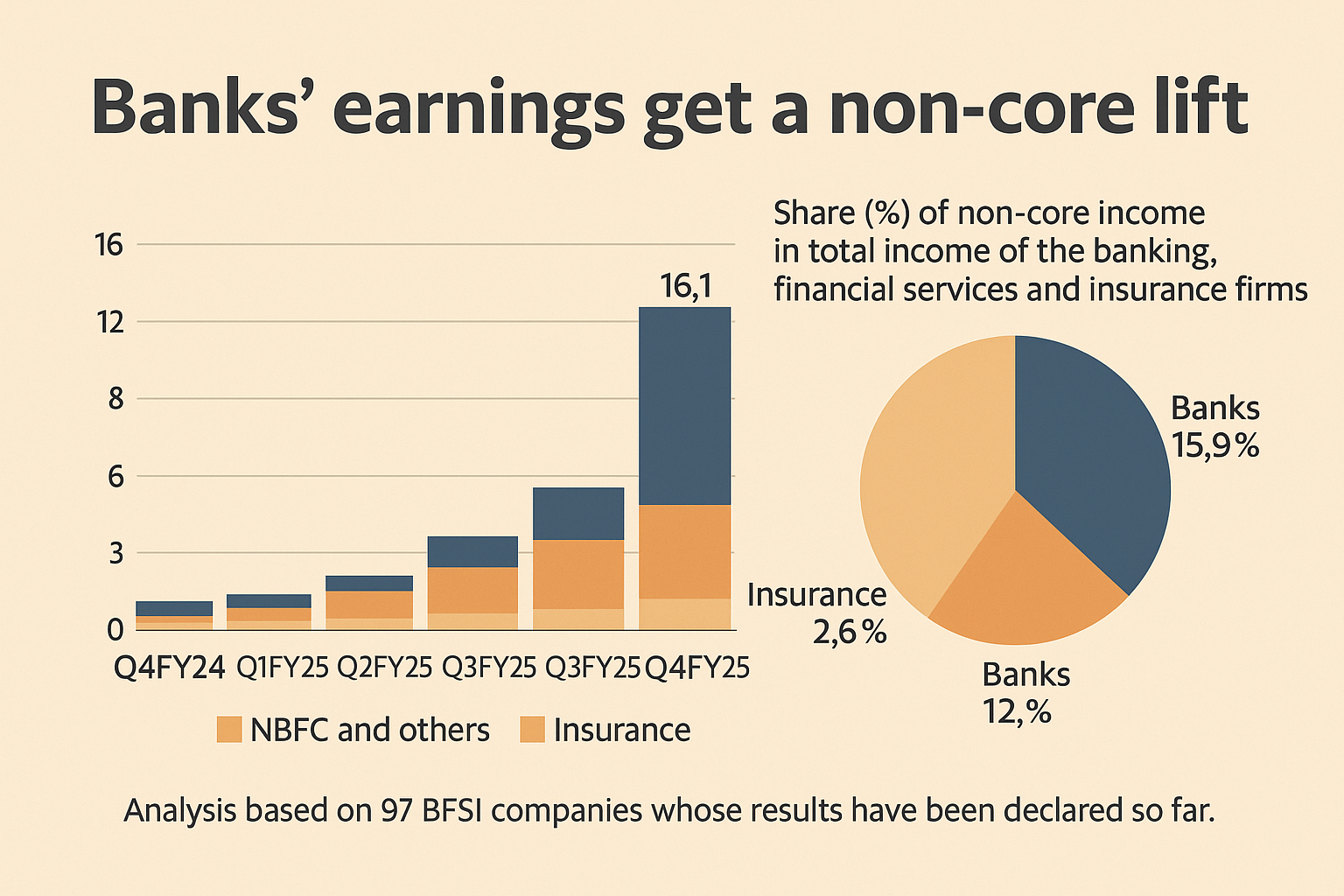
In a quarter marked by muted loan growth and subdued private sector investment, domestic banks have turned to a powerful ally to bolster their bottom lines—non-core or treasury income. An analysis of 97 listed banking, financial services, and insurance (BFSI) companies revealed a robust surge in banks’ overall income and profits in the January–March quarter (Q4FY25), driven largely by gains from government securities as bond yields declined.
The Treasury Tailwind
Banks’ non-core income—largely derived from gains on government securities—played a pivotal role this quarter, contributing 16% to total income, up significantly from 12.5% in the previous quarter. This sharp uptick reflects falling yields on G-secs, which lifted the mark-to-market valuation of banks’ bond portfolios.
The overall non-core income for banks surged by 35% quarter-on-quarter, while core income—mainly net interest income—grew a mere 1.6%. The contrast is stark, and it highlights the dependency of many banks on their treasury operations during times of sluggish credit growth.
Leading the charge was the State Bank of India (SBI), whose treasury gains leaped to ₹6,900 crore in Q4, up from ₹1,200 crore in Q3. This boost included a ₹3,900 crore reversal on government-guaranteed securities, according to Nuvama Institutional Equities.
Muted Loan Growth Masks Structural Concerns
This treasury-fueled performance comes even as core banking activities such as loan disbursement remain tepid. The RBI’s March data showed a slowdown in non-food credit growth, underlining the strain on core business expansion. This has been further compounded by a persistent lull in private sector capital expenditure (capex).
A recent National Statistical Office survey indicated only a marginal uptick in private capex for FY25, with a possible further dip ahead. A report by Elara Securities suggests that a meaningful recovery in corporate loan demand—and thereby, in banks’ core income—may still be distant.
Performance Snapshot: Q4FY25 Earnings at a Glance
Here’s how various BFSI sub-sectors fared:
| Metric | BFSI | Banks | NBFCs & Others | Insurance |
|---|---|---|---|---|
| Total Income YoY (%) | 4.4% | 9% | 17.3% | -23.1% |
| Non-core Income YoY (%) | 6.7% | 8.1% | -26.1% | -28.5% |
| Net Profit YoY (%) | 3.8% | 2.9% | 8% | 9.1% |
Banks, which made up just 29% of the 97 companies analyzed, contributed a massive 94% of the sector’s total non-core income. Insurance firms, with long-tenure bond holdings for ALM purposes, chipped in 4%, and NBFCs/others made up the remaining 2%.
NBFCs and Insurance: A Diverging Path
While NBFCs and asset management companies (AMCs) saw a downturn in non-core income—hit by their relatively low exposure to G-secs—they fared better on core metrics. For AMCs, core income and adjusted profits hit an eight-quarter high, with respective growth of 17% and 8%.
In contrast, insurance companies emerged as the quarter’s laggards. Traditionally strong in Q4 due to March-end bond gains, their non-core income plummeted 28.5% year-on-year, continuing a declining trend seen since FY23. Total income dropped 23%, although adjusted net profit rose modestly by 9%.
Outlook: Caution Amid Treasury Reliance
The heavy reliance on non-core income offers temporary relief but raises long-term concerns. Treasury gains are inherently volatile and subject to macroeconomic factors such as interest rates and fiscal policies. Without a meaningful revival in credit demand and private investment, banks’ profitability may remain vulnerable to fluctuations in bond markets.
Until then, treasury income will likely continue playing an outsized role in banks’ earnings profiles, offering a cushion as they navigate the still-fragile landscape of core business growth.
Feel free to share your experiences and insights in the comments below. Let’s continue the conversation and grow together as a community of traders and analysts.
By sharing this experience and insights, I hope to contribute to the collective knowledge of our professional community, encouraging a culture of strategic thinking and informed decision-making.
As always, thorough research and risk management are crucial. The dynamic nature of financial markets demands vigilance, agility, and a deep understanding of the tools at your disposal. Here’s to profitable trading and navigating the election season with confidence!
Ready to stay ahead of market trends and make informed investment decisions? Follow our page for more insights and updates on the latest in the financial world!
For a free online stock market training by Yogeshwar Vashishtha (M.Tech IIT) this Saturday from 11 am – 1 pm, please sign up with https://pathfinderstrainings.in/training/freetrainings.aspx
Experience profits with my winning algo strategies – get a free one-month trial with ₹15 lakh capital! – https://terminal.algofinders.com/algo-terminal
Disclaimer
This article should not be interpreted as investment advice. For any investment decisions, consult a reputable financial advisor. The author and publisher are not responsible for any losses incurred by investors or traders based on the information provided.