The year 2024 could well be the most happening year for the startup ecosystem in recent memory. A new cohort of startups is getting ready for the big show on the exchanges. But what about the earlier wave of consumer internet firms that hit the bourses? Zomato Ltd, in its current avatar as both a food delivery and a quick commerce company, stands out.
The company’s financials for the fourth quarter of 2023-24 are interesting and mark a turning point in its journey. Zomato reported a consolidated net profit of ₹175 crore for the quarter ending March, marking a 27% sequential growth over the previous quarter. The revenue growth of 8.3% was less than a third of the growth in profitability, indicating that the levers of profitability are being unlocked. These are important indicators not just for Zomato but for the entire venture capital (VC) funded startup ecosystem.
Sharp Turnaround
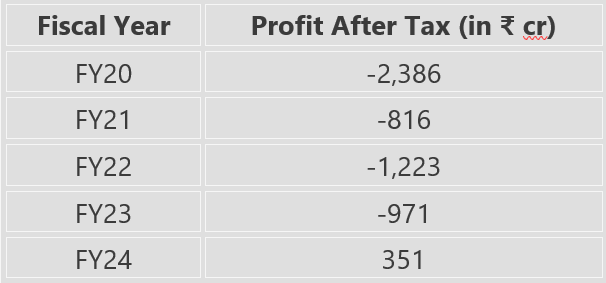
Zomato’s journey to profitability has been nothing short of remarkable. The company turned PAT positive in FY24, a significant achievement considering its financial trajectory in the preceding years. This turnaround offers valuable lessons for investors and venture capitalists (VCs) about strategic focus, execution excellence, and sustainable growth.
The 2021 IPO Wave and Market Realities
The year 2021 was seen as the coming of age of startups that were part of a new wave of India’s consumer internet era. A small cohort of these startups filed for initial public offerings (IPOs) and listed on the exchanges. Built and scaled with unprecedented amounts of capital, these IPOs were enthusiastically received by the markets, proving that this funding model worked despite skepticism.
However, as shareholders began losing money post-listing, the debate on whether startups without a stable revenue model and profits should have been allowed to list in the first place emerged frequently. The gap between winners and laggards is now evident, resembling the last lap of a marathon.
Lessons from post-IPO Journeys
The post-IPO journeys of startups have revealed critical lessons for investors and VCs. Notably, having a large total addressable market (TAM) is necessary but not sufficient for building a successful company. The success factors include:
Network Effect
A compelling network effect can significantly scale a business. For Zomato, the network effect was crucial in creating a vast user base that made it difficult for competitors to penetrate the market deeply.
Superior Solutions
The extent of superiority of the proposed solution over existing methods is crucial. Zomato’s pivot from a restaurant ratings platform to a food delivery service exemplifies this. The superior convenience offered by Zomato’s food delivery service over traditional dining options quickly won over customers.
Execution Excellence
The perfect combination of clarity, focus, and execution at every stage is essential. Zomato’s ability to execute its strategy effectively—whether it’s scaling operations or making strategic acquisitions like Blinkit—has been a key driver of its success.
Zomato’s Strategy and Success
Zomato has emerged as a winner on all these counts. Originally a ratings platform for restaurants, it quickly pivoted to food delivery, catching up with its rival Swiggy. The strong tailwind of network effects helped Zomato scale rapidly. Key milestones in Zomato’s journey include:
- 2008: Founded as foodiebay.com, a website for restaurant menus and reviews.
- 2010: Renamed to Zomato; received seed funding from Info Edge.
- 2013: $37 million funding round led by Sequoia.
- 2015: Launched food ordering and delivery in India.
- 2018: Ant Group invested $200 million, and Zomato became a unicorn.
- 2021: Raised $250 million from Tiger Global, Kora; went public.
- 2022: Acquired Blinkit to enter the quick commerce market.
- 2023: Turned PAT positive.
Market Dynamics and Future Outlook
The assumption that a large problem and ambitious founder backed by big capital equates to a big, profitable company turned out to be a fallacy in some cases. Some startups failed to build sustainable businesses, resulting in steep valuation corrections.
For instance, the struggles of online grocery chains versus the success of offline chains like DMart highlight that core business profitability is critical. Claims of leveraging extensive data mining to upsell and cross-sell products are largely myths unless the core product or service is profitable.
The Tech Bogey and Execution Realities
Over-indexing on technology without adequate focus on the core value proposition has often led to failure. Fintech startups, for example, claimed to use cutting-edge analytics for quick creditworthiness evaluations, but the underlying algorithms often lacked substance. Sustainable business building, thoughtful customer targeting, and steadfast focus on fundamentals are the true secret sauces.
Conclusion
Valuation mismatches with underlying business values are common in VC investing, driven by FOMO and excess capital. Corrections in valuation can be steep if poor execution creates niche competitors that offer better products and services.
As the startup ecosystem braces for new IPOs, the lessons from Zomato’s journey underscore the importance of sustainable growth, execution excellence, and profitability. Zomato can take a bow for reaching profitability and setting an example for others in the industry. Investors and VCs should heed these lessons as they navigate the dynamic landscape of startup investments.
SEO Keywords
- Indian Stock Market
- NSE
- NSE Stock Analysis
- Stocks
- Stocks to Buy
- Investment
- Investors
- Traders
- Zomato
- Zomato profitability
By focusing on these aspects, investors and VCs can better evaluate potential investments, ensuring they support businesses that are well-positioned for long-term success and profitability.
As Zomato’s story demonstrates, strategic focus and execution excellence are not just buzzwords—they are vital to transforming promising startups into profitable enterprises.
Disclaimer:
The information presented in this article has been compiled from multiple sources across the internet. It is intended for informational purposes only and should not be construed as investment advice. Any investment decisions should be made in consultation with a reputable financial advisor. The author and publisher of this article are not liable for any losses incurred by investors or traders as a result of the information provided.