
While trading the stock market, one of the most valuable tools many traders overlook is the “Ease of Movement” indicator. This uncommon yet powerful tool can provide valuable insights into a stock’s price action and help traders identify potential trends and reversals. Let us understand the Ease of Movement, its calculation, and its uses to make better trading decisions.
Ease of Movement (EMV) is a technical indicator developed by Richard W. Arms Jr. Its primary function is to measure the ease with which a stock’s price moves upward or downward. It combines price action and trading volume, providing a unique perspective on the market’s buying and selling pressures.
The EMV oscillates above and below the zero line. Positive values indicate positive price movement with relatively low volume, while negative values suggest negative price movement with low volume.

Calculation for Ease of Movement
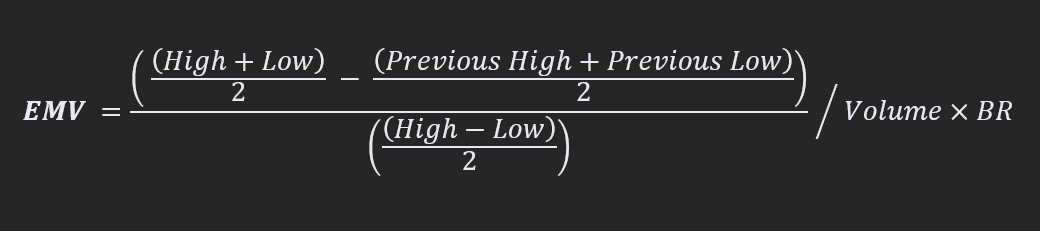
Calculating the Ease of Movement indicator involves two primary components: the box ratio (BR) and the one-period percentage change in price.
Step 1 –
Box Ratio (BR): The box ratio is a crucial parameter in the EMV calculation. It represents the ratio between the current price range and the volume. A higher box ratio suggests a more significant price move than the volume traded, indicating stronger buying or selling pressure.
Step 2 –
One-Period Percentage Change in Price: This component measures the percentage change in the stock’s price over a single period. It considers the high and low prices of the period and calculates the percentage change.
Step 3 –
The formula calculation is as follows:
Interpreting Ease of Movement
The Ease of Movement oscillator hovers around the zero line, with positive and negative values indicating different market conditions:
Positive EMV – A positive EMV value suggests that the stock’s price rises with little resistance, indicating a bullish trend. It implies buyers are willing to push the price higher without significant volume, signalling strong buying interest.
Negative EMV – A negative EMV value indicates that the stock’s price is falling with little resistance, suggesting a bearish trend. It implies that sellers are lowering the price without significant volume, signalling strong selling interest.
Zero EMV – A zero reading suggests that the stock’s price is relatively flat or moving sideways, with no strong bias from buyers or sellers.
Using Ease of Movement in Trading Strategies
Divergence – Consider divergences between the stock’s price and the EMV indicator. A bullish divergence is present when the price makes lower lows, but the EMV makes higher lows, suggesting a potential upward reversal. Conversely, a bearish divergence is current when the price makes higher highs, but the EMV makes lower highs, indicating a possible downward reversal.
Confirmation of Trends – EMV can confirm the strength of a prevailing trend. Rising EMV values during an uptrend indicate strong buying pressure while falling EMV values during a downtrend suggest increasing selling pressure.
Identifying Reversals – Extreme values on the EMV can signal potential market reversals. When EMV reaches extremely high positive or negative levels, it might suggest that the price is overbought or oversold, respectively, and a reversal is likely.
Volume Confirmation – Combining EMV with trading volume can provide additional insights. A surge in EMV with high trading volume validates the strength of a trend, while a decrease in EMV with rising volume might indicate a weakening trend.
Summary
The Ease of Movement indicator is a valuable tool that offers unique insights into the stock market’s buying and selling pressures. By incorporating EMV into their analysis, traders can better understand trends, potential reversals, and market strength. As with any technical indicator, using Ease of Movement with other tools and analysis methods is essential to make well-informed trading decisions. So, next time you analyze a stock chart, consider the Ease of Movement for a more comprehensive market view.
Disclaimer: We do not endorse or encourage you to take trades or investment decisions based upon our posts/research, all of your trading and investment activities are your own and should be taken through consultation with reputed financial advisors. The analysis posted on this website has been created by involving multiple mediums which are present over the Internet.