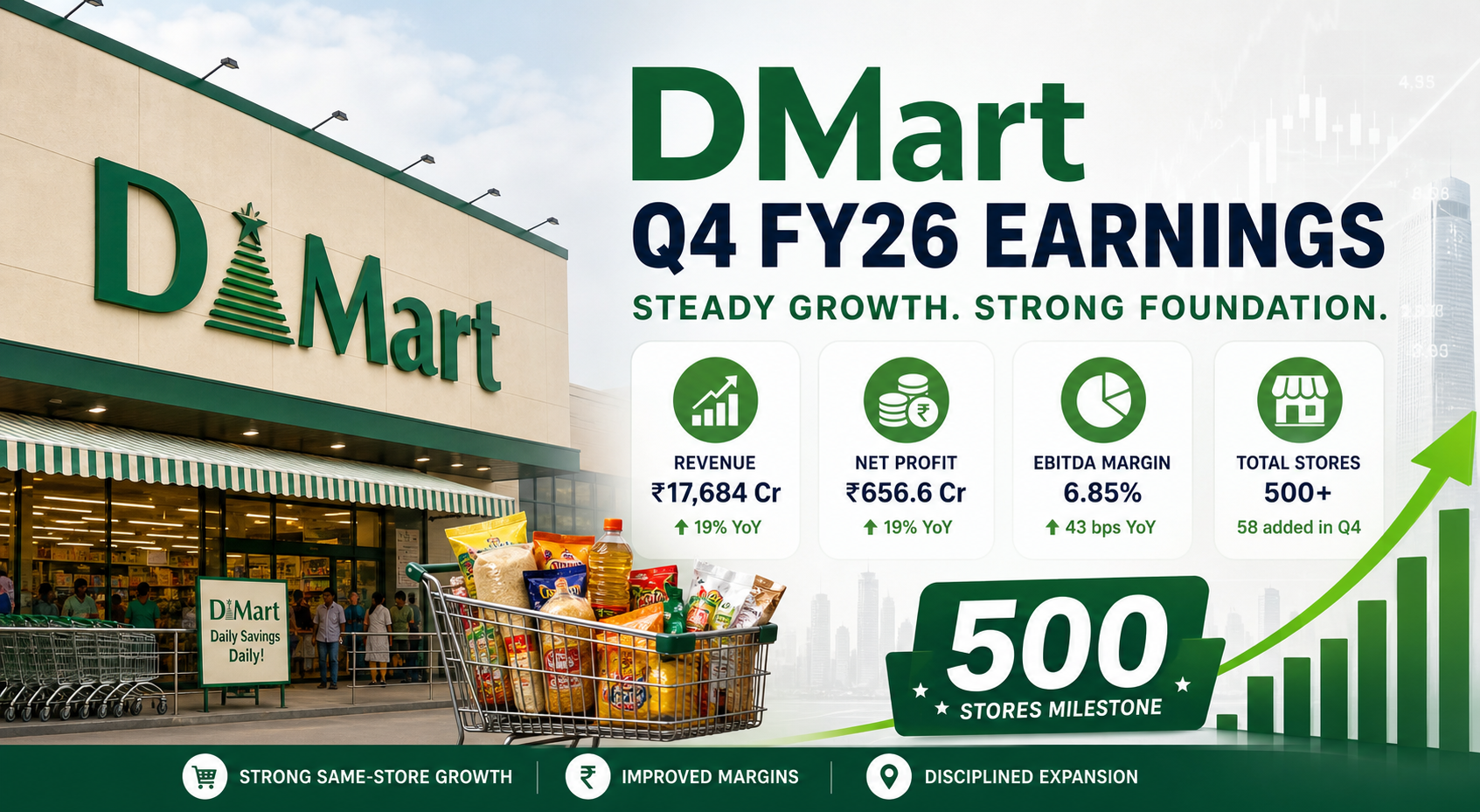
DMart’s Q4 FY26 earnings tell the story of a retailer that continues to do what it is known for: grow steadily, expand carefully, and keep its operating model focused on value. Avenue Supermarts, the company behind DMart, reported a healthy March-quarter performance, with both revenue and profit rising around 19% year-on-year. But beyond the headline numbers, the quarter also carried a larger symbolic moment — DMart crossed the 500-store mark, underlining how far the brand has travelled from being a regional value retailer to one of India’s most closely watched retail chains.
A Quarter Built on Consistent Growth
For the quarter ended March 31, 2026, Avenue Supermarts reported consolidated revenue from operations of ₹17,684 crore, up from ₹14,872 crore in the same quarter last year. Net profit attributable to shareholders rose to ₹656.6 crore, compared with ₹550.9 crore in Q4 FY25.
This performance reflects the strength of DMart’s core formula: high-volume retailing, sharp cost control, and a customer proposition built around everyday low prices. In a market where consumer spending can often be uneven, DMart’s grocery-led model continues to give it a defensive edge.
Margins Offer a Positive Signal
The most encouraging part of the quarter was not just the revenue growth, but the improvement in operating profitability. EBITDA rose 26.7% year-on-year to about ₹1,210.5 crore, while EBITDA margin expanded to around 6.85% from 6.42% a year earlier.
For a low-margin retail business, even a modest margin improvement is meaningful. It suggests that the company managed its costs well despite expansion, while also benefiting from better operating leverage. NDTV Profit similarly reported that EBITDA margin improved to 6.84%, helped by stronger operating performance.
The 500-Store Moment
DMart’s expansion was one of the defining themes of the quarter. The company added 58 stores during Q4 FY26 and ended the year with 500 stores, including one Sanpada store in Navi Mumbai that remained closed for reconstruction.
This milestone matters because DMart’s growth has historically been disciplined rather than flashy. The company has preferred ownership or long-term control of store economics, careful location selection, and cluster-based expansion. Crossing 500 stores shows that the model is scaling, but the real test will be how quickly newer stores mature and begin contributing meaningfully to profitability.
Mature Stores Show Better Traction
Avenue Supermarts also indicated that mature stores — those operational for more than two years — grew 10.8% during the quarter, compared with 8.1% in Q4 FY25. This is an important operating indicator because same-store or mature-store growth shows whether existing locations are gaining customer traction beyond new-store additions.
In simple terms, DMart’s growth was not only coming from opening more stores; older stores were also performing better. That adds quality to the revenue growth.
Full-Year FY26: Strong Top Line, Softer Profit Growth
For the full financial year FY26, Avenue Supermarts reported total revenue of ₹66,968 crore, up 15.9% year-on-year. EBITDA grew 15.7% to ₹5,255 crore, while profit after tax rose 10.1% to ₹3,224 crore. Basic EPS for the year stood at ₹49.54, compared with ₹44.98 in FY25.
The full-year numbers show a business still expanding strongly, though profit growth lagged revenue growth. That is not unusual for a retailer investing aggressively in new stores, supply chain, people, and operating infrastructure. However, it also means investors will be watching whether expansion-led costs remain controlled in FY27.
A Brief Boost from March Buying
One interesting management observation was that geopolitical tensions led to a temporary spike in consumer buying in March 2026, which later normalised toward the end of the month. The company also said it had not faced significant supply-chain disruptions so far.
This suggests that part of the quarter’s momentum may have received a short-term lift, but the broader story still rests on store expansion, mature-store growth, and steady demand for essential categories.
Market Reaction: Good Numbers, But High Expectations
Despite the strong results, DMart shares fell after the earnings announcement, with reports noting a decline of nearly 4%. The reaction highlights a familiar issue with DMart: the company is admired for its quality, but the stock often trades with high expectations built in.
Brokerage commentary appeared mixed, with concerns around cost pressures, margin sustainability, slower discretionary demand, and valuation. At the same time, analysts continued to acknowledge DMart’s strong long-term market position.
Conclusion: A Solid Quarter, With the Next Test Ahead
DMart’s Q4 FY26 performance was strong on the surface and reasonably healthy underneath. Revenue grew, profits rose, EBITDA margins improved, mature stores performed better, and the company crossed 500 stores. These are all signs of a retailer that remains operationally disciplined and competitively relevant.
The next chapter, however, will depend on execution. As DMart expands deeper into new markets, the focus will shift from merely adding stores to making those stores mature profitably. If the company can preserve its value-retail DNA while improving productivity across its expanding network, FY27 could become another important year in DMart’s long-term growth story.
Key takeaways: DMart delivered 19% revenue and profit growth in Q4 FY26, improved EBITDA margins, added 58 stores during the quarter, crossed the 500-store milestone, and ended FY26 with ₹66,968 crore in annual revenue. The business remains strong, but investor expectations remain equally demanding.
Feel free to share your experiences and insights in the comments below. Let’s continue the conversation and grow together as a community of traders and analysts.
By sharing this experience and insights, I hope to contribute to the collective knowledge of our professional community, encouraging a culture of strategic thinking and informed decision-making.
As always, thorough research and risk management are crucial. The dynamic nature of financial markets demands vigilance, agility, and a deep understanding of the tools at your disposal. Here’s to profitable trading and navigating the election season with confidence!
Ready to stay ahead of market trends and make informed investment decisions? Follow our page for more insights and updates on the latest in the financial world!
For a free online stock market training by Yogeshwar Vashishtha (M.Tech IIT) this Saturday from 11 am – 1 pm, please sign up with https://pathfinderstrainings.in/training/freetrainings.aspx
Experience profits with my winning algo strategies – get a free one-month trial with ₹15 lakh capital! – https://terminal.algofinders.com/algo-terminal
Disclaimer
This article should not be interpreted as investment advice. For any investment decisions, consult a reputable financial advisor. The author and publisher are not responsible for any losses incurred by investors or traders based on the information provided.