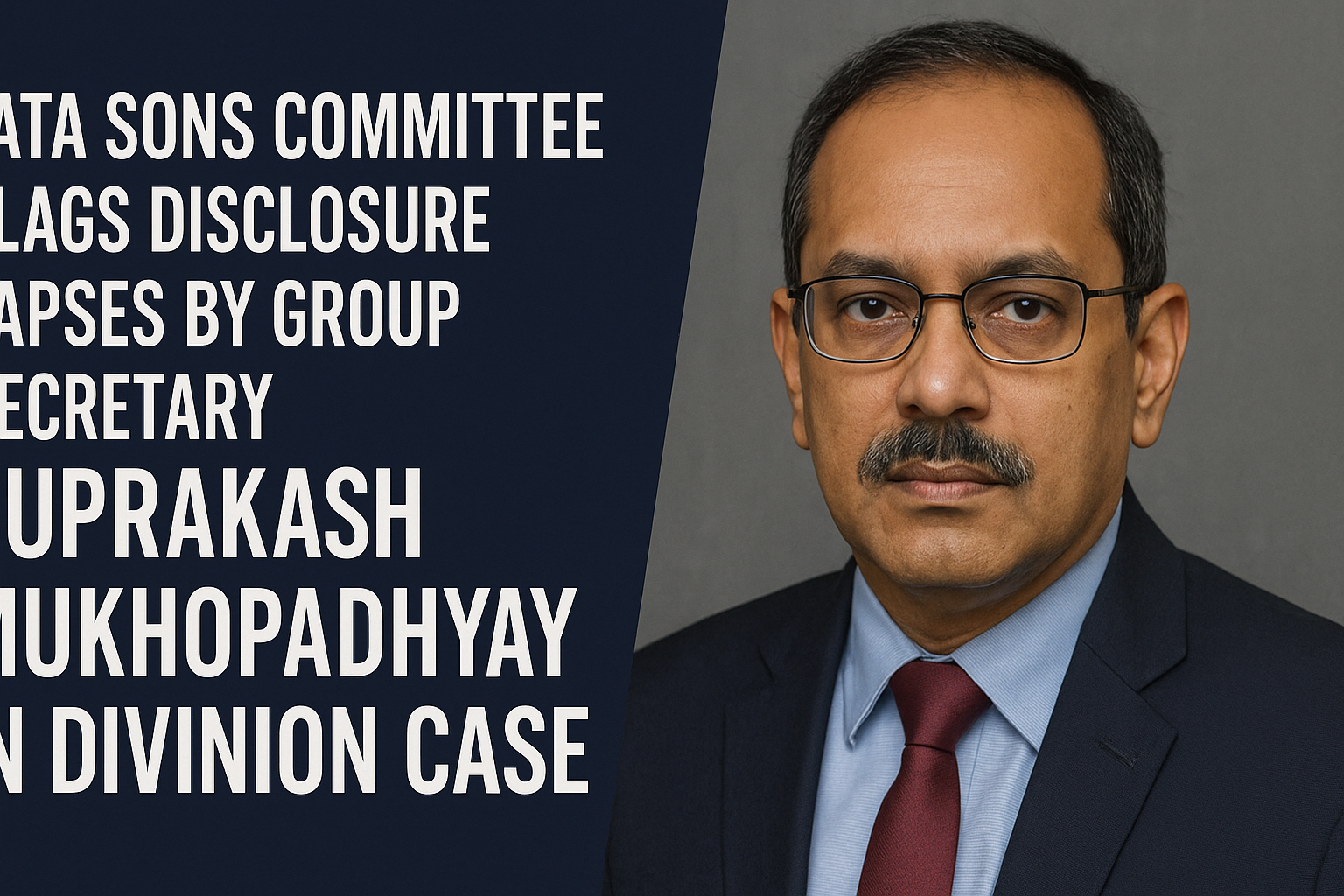
Governance within a corporate giant like Tata Sons isn’t just a legal obligation; it’s a symbol of trust and transparency in a brand that is, arguably, India’s most respected conglomerate. However, recent allegations surrounding Suprakash Mukhopadhyay, Tata Sons’ Group Company Secretary, have sparked serious conversations about disclosure norms and integrity within the organization.
An internal committee of Tata Sons recently flagged significant lapses by Mukhopadhyay regarding his ties to his family’s wealth management firm, Divinion, raising questions not only about internal compliance but also about how custodians of governance must lead by example. What are the details of the case, and what are the broader implications for corporate governance? Here’s a detailed analysis.
Key Findings from Tata Sons’ Internal Committee
An internal committee, comprising Tata Sons’ HR head Nupur Mallick, finance executive Eruch N. Kapadia, and group general counsel Sidharth Sharma, tabled a report highlighting three major lapses in disclosure by Mukhopadhyay. However, the committee refrained from concluding that these lapses had malicious intent. Here’s what they found:
1. Non-Disclosure of Ties to Divinion
One of the most prominent findings was Mukhopadhyay’s failure to adequately disclose his association with Divinion, a wealth management firm entirely owned by his family. He reportedly played an active role in soliciting contributions from former Tata Group employees and professional advisors to Divinion. Failure to disclose such active involvement raises questions about whether potential conflicts of interest were effectively managed.
2. Transaction of CSR Funds
The case also involved a transaction in which CSR funds from Tata Investment Corporation were used for purchasing a property in Kolkata from Mukhopadhyay’s in-laws. This property later became a key asset of Divinion Foundation Trust, linked to his family. The lack of transparency here has highlighted the complex relationship between company social responsibility ventures and private interests.
3. Possible Governance Risks
Mukhopadhyay actively encouraged former Tata Group employees and external advisors to collaborate with Divinion, which could create real or perceived conflicts of interest, particularly because of his high-ranking position and close relationship with Tata Sons Chairman Natarajan Chandrasekaran.
Committee’s Verdict
Despite these significant lapses, the internal report emphasized no evidence pointed to deliberate misconduct or intent to profit personally. It stated, “There does not appear to be any intentional breach of the Tata Code of Conduct or mala fide intent on his part to make a personal gain.”
Following the Money Trail
A deeper investigation into Divinion’s financial details revealed an interesting timeline and growth pattern:
- CSR Contribution: Tata Investment Corporation’s FY24 filings detailed a ₹10 lakh CSR contribution to Divinion Foundation Trust.
- Property Purchase: Mukhopadhyay admitted to using ₹1.33 crore of CSR funds in FY25 to purchase a property from his wife’s parents, intended as a learning center under Divinion Foundation Trust.
These transactions, while ostensibly intended for altruistic purposes, underscore the murky overlap between personal and professional finances.
Divinion’s Ownership
Divinion’s ownership has remained within Mukhopadhyay’s family since its inception in 2021. Initially, his wife Paromita and eldest daughter Shreemoyee held equal shares. By FY24, ownership was equally distributed among Paromita and their two daughters.
Interestingly, the firm has exhibited rapid financial growth, with revenue rising from ₹40.9 lakh in FY23 to ₹1.94 crore in FY24. Divinion manages the Divinion Alternative India Fund, a SEBI-registered equity vehicle, adding another layer of complexity to the scrutiny.
The Governance Questions at Stake
This case has important implications for a company like Tata Sons, which oversees a $165 billion empire and has historically been regarded as a touchstone for corporate governance in India.
1. Lack of Disclosure as a Governance Risk
The lack of full disclosure by someone as senior as the Group Company Secretary raises significant concerns. Even if no deliberate misconduct was identified, the act of withholding information about connections to a private entity can undermine trust and transparency at the organizational level.
2. Can Internal Probes Be Enough?
While Tata Sons acted swiftly by initiating an internal investigation after media reports surfaced, some voices in the corporate world argue that an independent external review would provide more clarity and reinforce trust with stakeholders. V. Balakrishnan, former CFO at Infosys, remarked, “Good corporate governance requires that a competent, independent external agency thoroughly investigates any matters relating to key management personnel.”
3. The Role of Leadership
Mukhopadhyay’s close association with Chairman Chandrasekaran also places the leadership under the microscope. The case raises pertinent questions about whether governance processes are robust enough to ensure accountability, even among senior personnel.
What Lies Ahead for Tata Sons?
The findings now rest with Tata Sons’ nine-member board, which must decide whether the internal committee’s report is sufficient or if deeper, external oversight is warranted. The decision will not only have significant implications for Mukhopadhyay’s future but also for Tata Sons’ broader efforts to reinforce its commitment to ethical principles.
This case also comes as Tata Sons faces intensified scrutiny over governance practices across its sprawling portfolio, from Tata Motors to Tata Steel and Tata Consultancy Services. How the board handles this issue will serve as a litmus test for Tata’s continued adherence to its storied legacy of transparency and integrity.
Final Thoughts
The Mukhopadhyay case is a timely reminder of the importance of solid governance mechanisms, especially in conglomerates the size of Tata Sons. While the lapses may not have been malicious, the need for tighter oversight and proactive disclosure policies cannot be overstated.
For Tata Sons, the challenge is clear-cut yet significant. Can they appropriately balance the need for swift accountability without undermining the organization’s leadership? The corporate world is watching closely to see if Tata Sons preserves its reputation as a paragon of governance or falters under internal scrutiny.
The coming months promise developments that will likely provide critical takeaways for businesses worldwide striving to uphold governance in an era of increasing complexity.
Feel free to share your experiences and insights in the comments below. Let’s continue the conversation and grow together as a community of traders and analysts.
By sharing this experience and insights, I hope to contribute to the collective knowledge of our professional community, encouraging a culture of strategic thinking and informed decision-making.
As always, thorough research and risk management are crucial. The dynamic nature of financial markets demands vigilance, agility, and a deep understanding of the tools at your disposal. Here’s to profitable trading and navigating the election season with confidence!
Ready to stay ahead of market trends and make informed investment decisions? Follow our page for more insights and updates on the latest in the financial world!
For a free online stock market training by Yogeshwar Vashishtha (M.Tech IIT) this Saturday from 11 am – 1 pm, please sign up with https://pathfinderstrainings.in/training/freetrainings.aspx
Experience profits with my winning algo strategies – get a free one-month trial with ₹15 lakh capital! – https://www.terminal.algofinder.in/auth/register
Disclaimer
This article should not be interpreted as investment advice. For any investment decisions, consult a reputable financial advisor. The author and publisher are not responsible for any losses incurred by investors or traders based on the information provided.