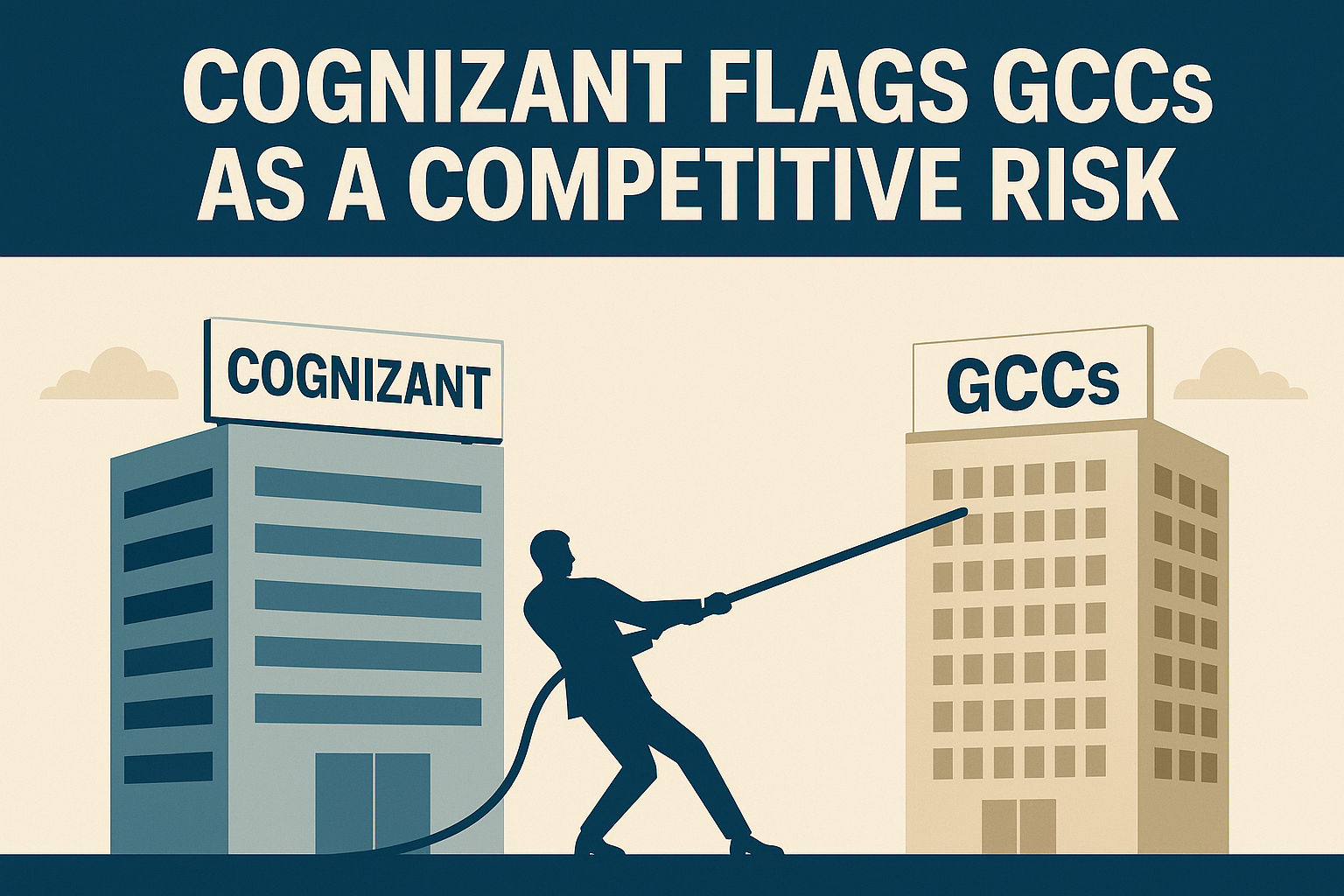
Cognizant Technology Solutions recently made waves in its annual report by labeling Global Captive Centres (GCCs) as a potential business risk. This acknowledgment highlights a dramatic pivot in how major IT services firms are viewing the accelerating growth and influence of client-operated technology centers. Once considered cost-effective back-office operations, GCCs have evolved into sophisticated hubs of digital innovation, reshaping the competitive dynamics of the IT services industry.
This blog explores the implications of Cognizant’s bold acknowledgment, the rise of GCCs as strategic players, and the broader ripple effects on the Indian IT services market.
GCCs: No Longer Just Back Offices
Cognizant’s report shed light on a subtle but significant realization within the IT industry. The company stated, “We face competition from clients’ in-house technology resources, such as GCCs, which may provide a lower-cost alternative to our services.” This important remark goes beyond acknowledging GCCs’ cost-effectiveness. It underscores the challenge IT service providers face in competing for talent—not just with peers but also with their clients’ highly capable internal technology centers.
The rapid rise of GCCs globally, especially in India, adds weight to this concern. Nasscom estimates that India is currently home to nearly 1,700 GCCs, and this number is projected to rise to 2,200 by 2030, commanding a market size of $105 billion. No longer limited to back-office support, GCCs have transformed into centers of digital excellence for companies like Microsoft, Amazon, and JP Morgan Chase.
GCCs now lead critical initiatives in AI, automation, cybersecurity, and Agile innovation, placing them at the forefront of global technology. Their ability to take ownership of high-value IT functions is a disruptor, redefining the traditional role of outsourcing.
Cognizant’s Evolving Strategy
Interestingly, while Cognizant identifies GCCs as competition, it also recognizes them as collaborative opportunities. Cognizant has already signed approximately 10 deals with GCCs, signaling that these partnerships are a “growth priority.” This dual approach reflects the nuanced strategy laid out by CEO S. Ravi Kumar during the company’s March investor meeting. Ravi Kumar’s roadmap emphasizes profitability, large deal wins, market share expansion, and bridging the gap with the world’s top four IT services providers by March 2027.
With nearly 75% of its workforce based in India, Cognizant’s adaptability in managing the rise of GCCs is critical. Whether the company can turn GCCs into allies or fails to stay competitive will define its trajectory in the years to come.
Industry-Wide Implications
Cognizant is not alone in grappling with GCCs’ growing prominence. HCL Technologies was the first major Indian IT firm to officially identify GCCs as a business risk in its 2023 annual report. Since then, the trend has only intensified.
Recent developments underscore this shift:
- Transamerica, a unit of Dutch insurer Aegon NV, terminated a $2 billion outsourcing deal with Tata Consultancy Services (TCS) midway and decided to insource its digital transformation capabilities.
- State Street, a financial services giant, transitioned its joint venture with HCLTech into an entirely in-house operation following over a decade of collaboration.
These moves by major clients reflect their growing confidence in managing technology operations internally. GCCs no longer merely complement outsourcing agreements; they increasingly replace them.
IT Firms’ Strategic Recalibration
The evolution of the GCC model demands a recalibrated approach from IT service providers, forcing them to rethink how they remain relevant in a world where control, speed, and flexibility are prized. Some IT firms are not only tolerating but actively supporting the rise of GCCs. Companies like Infosys, Wipro, and Tech Mahindra are leveraging the build-operate-transfer (BOT) model to establish captives for clients and hand over operational control when ready.
Even global powerhouse Accenture is making strides in this space. Its equity investment in ANSR, India’s leading firm focused on GCC establishment, reflects its intent to play a guiding role in this evolution. The shift from resistance to alignment shows that success in this new era depends on collaboration and innovation.
GCCs and the Escalating Talent War
An undeniable consequence of GCC growth is the intensified battle for technology talent. Cognizant’s report highlights a critical pain point faced by IT service providers: competing for skilled professionals not just with peers but also their clients’ GCCs.
GCCs are magnetizing top talent across expertise areas such as AI, cloud computing, cybersecurity, and enterprise transformation. Their ability to offer competitive salaries, advanced training, and opportunities to work on cutting-edge projects is reshaping the talent landscape, raising the stakes for IT firms to retain their workforce.
The Road Ahead
The rise of GCCs is not merely a trend; it’s a structural transformation that adds complexity and opportunity to the offshore IT services market. For players like Cognizant, striking a balance between leveraging GCCs as partners and mitigating them as competitors is key to staying ahead.
Cognizant’s decision to openly identify GCCs as both a risk and an opportunity could serve as a turning point for the broader IT services sector. By addressing this evolution head-on, the company is signaling its intent to adapt its business model to the changing market dynamics.
The coming years will determine whether IT service providers can redefine their value proposition to thrive alongside GCCs. What’s clear is that the traditional boundaries in IT outsourcing are dissolving—but with every challenge comes an opportunity to innovate and lead.
Feel free to share your experiences and insights in the comments below. Let’s continue the conversation and grow together as a community of traders and analysts.
By sharing this experience and insights, I hope to contribute to the collective knowledge of our professional community, encouraging a culture of strategic thinking and informed decision-making.
As always, thorough research and risk management are crucial. The dynamic nature of financial markets demands vigilance, agility, and a deep understanding of the tools at your disposal. Here’s to profitable trading and navigating the election season with confidence!
Ready to stay ahead of market trends and make informed investment decisions? Follow our page for more insights and updates on the latest in the financial world!
For a free online stock market training by Yogeshwar Vashishtha (M.Tech IIT) this Saturday from 11 am – 1 pm, please sign up with https://pathfinderstrainings.in/training/freetrainings.aspx
Experience profits with my winning algo strategies – get a free one-month trial with ₹15 lakh capital! – https://www.terminal.algofinder.in/auth/register
Disclaimer
This article should not be interpreted as investment advice. For any investment decisions, consult a reputable financial advisor. The author and publisher are not responsible for any losses incurred by investors or traders based on the information provided.