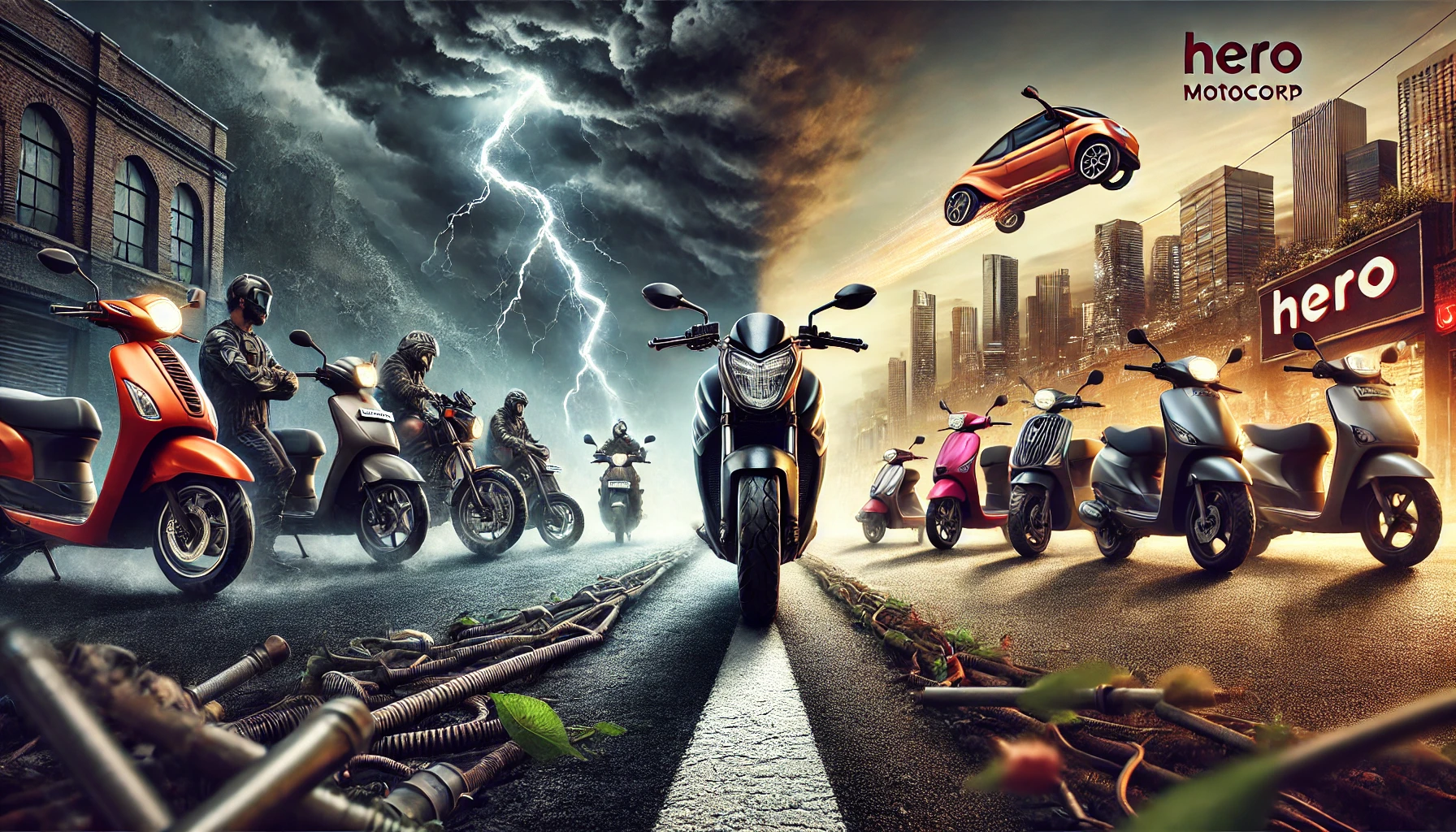
Hero MotoCorp, the undisputed leader of India’s two-wheeler market for decades, is facing unprecedented challenges. Market share losses, leadership upheavals, and struggles in the premium and electric vehicle (EV) segments are testing the resilience of the world’s largest two-wheeler manufacturer. Coupled with intensifying competition and shifting consumer preferences, Hero finds itself at a crossroads.
This blog takes a deep dive into Hero MotoCorp’s current challenges, its attempts to adapt, and whether it can reclaim its former glory.
Falling Market Share: Hero’s Biggest Challenge
Once the dominant player in India’s two-wheeler market, Hero’s market position is shrinking at an alarming rate. Its market share dropped from 31.3% in 2023 to 29.0% in 2024 and further hit a decade-low of 26.9% by January 2025. Behind these numbers lies a concerning trend—the company’s heavy dependence on commuter motorcycles at a time when consumer preferences are evolving.
Failing Connectivity in Evolving Markets
While rival companies like Ola Electric, Bajaj Auto, and TVS Motor focused on gearless scooters and entry-level EVs, Hero struggled to address the increasing demand for these segments. This lack of adaptation has left Hero trailing in important growth categories.
Hero’s entry into the EV race with its VIDA electric scooter range in FY23 was an example of promising potential with poor follow-through. High costs, quality concerns, and underwhelming features limited initial interest. The sales tell the story—Hero sold only 1,615 electric scooters in January 2025, far behind Ola Electric’s 24,336 units during the same period. Even Ola’s own results were subpar that month, underscoring the sluggish demand Hero has yet to overcome.
Missed Opportunities in the Premium Segment
The premium motorcycle market also represents an uphill battle for Hero. Despite its partnership with Harley-Davidson in 2020 to produce the Harley X440 in India, Hero struggled to launch in a timely manner. The three-year delay allowed competitors to seize a commanding lead in the high-margin premium segment.
Together, sluggish progress in capturing premium and EV markets highlights Hero’s struggles to adapt to a rapidly changing landscape.
Leadership Instability Deepens the Struggles
Hero MotoCorp’s challenges extend beyond operational hurdles—it faces significant leadership instability. A wave of high-profile resignations, including CEO Niranjan Gupta and Chief Business Officer Ranjivijit Singh in 2025, has raised eyebrows. Both executives were instrumental in guiding Hero’s premium and EV strategy, which until now, has delivered underwhelming results. Additional key exits, such as Reema Jain (Chief Information and Digital Officer) and Sameer Pande (Head of Talent Management), suggest deeper organizational challenges.
The company has tried to allay concerns, claiming that leadership transitions are a natural component of large organizations. For now, Chief Technology Officer Vikram Kasbekar is doubling as interim CEO until a permanent replacement is announced. However, how Hero rebuilds its leadership team in the coming months will be pivotal for its recovery.
Steps Toward Reinvention
Despite these difficulties, Hero MotoCorp is not standing still. It is attempting to jumpstart a comeback through its ambitious Vision 2030 strategy, built on three pillars:
- Strengthening its core business
- Accelerating its presence in the EV market
- Expanding its footprint in the premium two-wheeler segment
Expanding Offerings in Premium Motorcycles
Hero is upping its stakes in premium motorcycles to compete with established players. At the Bharat Mobility Expo in 2025, the company unveiled several new models, including the Xtreme 250R and Xpulse 210 motorcycles, alongside its Xoom 125 and Xoom 160 scooters. Leveraging partnerships with high-end brands like Harley-Davidson, this marks a bold attempt to address the glaring premium segment gaps.
Doubling Down on EVs
The electric revolution waits for no one. Hero is making aggressive forays into EVs with investments in mass-market electric scooters, such as those from its VIDA platform. Its plans to expand EV distribution to over 200 cities by FY26 highlight the company’s commitment to the segment. Additionally, an investment in Euler Motors signals Hero’s strategy to enter the three-wheeler EV space.
Compliance with the government’s Production-Linked Incentive (PLI) scheme is also part of Hero’s roadmap to reduce EV production costs and compete more effectively on price.
Leveraging Macro Tailwinds
The Union Budget of 2025 includes measures expected to lift consumer sentiment, particularly in India’s rural markets—a traditional stronghold for Hero MotoCorp’s commuter bikes. Additionally, the festive and wedding seasons could further spur demand for core motorcycle categories.
Financial Stability Provides Cushion for Recovery
While Hero grapples with operational inefficiencies and market share erosion, its financial performance remains robust, providing the company with some breathing room:
- Revenue Growth: Revenue for FY24 increased by 10.6% YoY due to higher exports and global expansions. Recent quarterly sales grew 5% YoY to ₹10,211 crore.
- Profit Margins: Operating profit grew by 8.4%, with margins improving to 14.5%. Profit per vehicle continues to remain strong, with EBITDA per vehicle crossing ₹10,000.
- Strong RoE and RoCE: Hero’s return-on-equity (RoE) and return-on-capital-employed (RoCE) stand at 21.8% and 29.5%, respectively, outperforming many of its peers.
- Low Debt: The company maintains a near-zero debt-to-equity ratio, giving it financial flexibility.
This financial stability allows Hero the opportunity to invest in restructuring its business while managing the pressures of intensifying competition.
Will the Road Ahead Lead to Recovery?
The challenges facing Hero MotoCorp underscore the increasingly steep demands being placed on legacy market leaders. Leadership transitions, delayed responses to market shifts, and intensified competition are hurdles that will require strategic agility to overcome.
However, Hero’s financial resilience and renewed premium/EV strategy offer reasons for optimism. If the company can execute its Vision 2030 strategy effectively—accelerating its moves in key growth markets and leveraging macroeconomic trends—it can begin reclaiming lost ground.
For now, the road to recovery remains long. Hero’s ability to adapt, innovate, and rebuild will determine whether it can reclaim its historic two-wheeler dominance or concede its position to more agile competitors.
Feel free to share your experiences and insights in the comments below. Let’s continue the conversation and grow together as a community of traders and analysts.
By sharing this experience and insights, I hope to contribute to the collective knowledge of our professional community, encouraging a culture of strategic thinking and informed decision-making.
As always, thorough research and risk management are crucial. The dynamic nature of financial markets demands vigilance, agility, and a deep understanding of the tools at your disposal. Here’s to profitable trading and navigating the election season with confidence!
Ready to stay ahead of market trends and make informed investment decisions? Follow our page for more insights and updates on the latest in the financial world!
For a free online stock market training by Yogeshwar Vashishtha (M.Tech IIT) this Saturday from 11 am – 1 pm, please sign up with https://pathfinderstrainings.in/training/freetrainings.aspx
Experience profits with my winning algo strategies – get a free one-month trial with ₹15 lakh capital! – https://www.terminal.algofinder.in/auth/register
Disclaimer
This article should not be interpreted as investment advice. For any investment decisions, consult a reputable financial advisor. The author and publisher are not responsible for any losses incurred by investors or traders based on the information provided.